
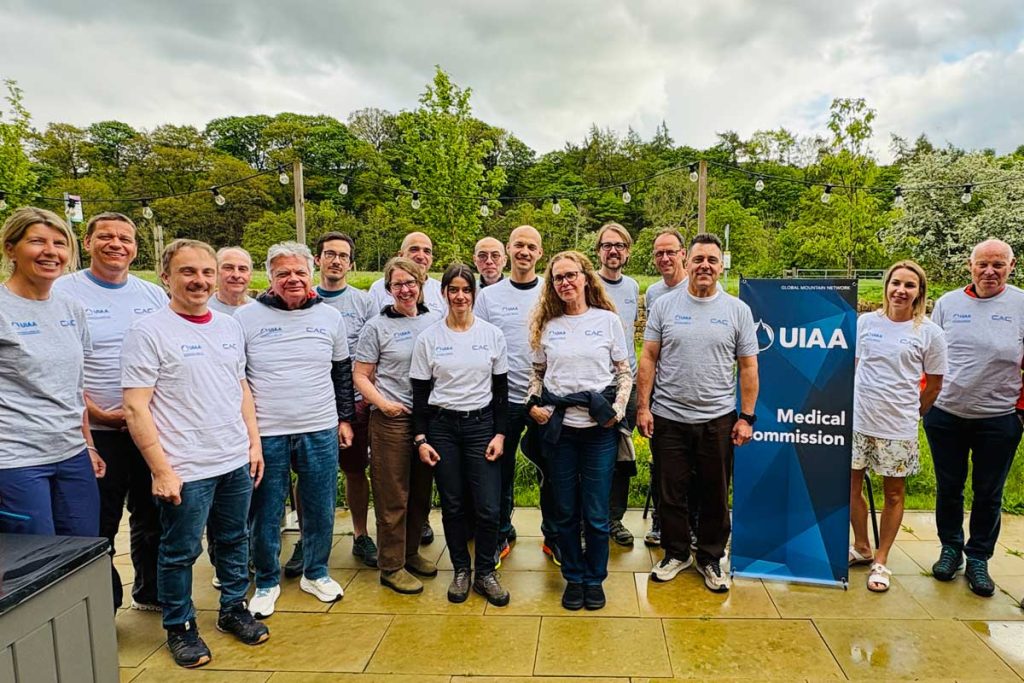
Delegates from the UIAA Medical Commission (MedCom) gathered in Hathersage, England, from 17-20 May both for the Commission’s annual meeting and as a partner of the World Congress on Mountain Medicine. The UIAA partnered with Namah Ropes and the Swiss Society of Mountain Medicine (SGGM) for the events in the Peak District.
Spearheading the delivery of new high-altitude and medical advice
The core of the Commission’s annual meeting focused on the progress of ongoing scientific and educational projects, notably the delivery of two papers. One of the most advanced initiatives remains the Children at Altitude project. The working group reported that structured recommendations and PICO questions had now been completed, with evidence reviews summarised using systematic review methodology. Final recommendations and a lay-person summary are currently being prepared. This is a revision to the paper published in 2008.
Another major topic was the Commission’s work on Older Mountaineers. Two parallel projects are underway: a scientific scoping review and a practical FAQ resource. The scientific review is examining acclimatisation, safe movement in exposed terrain, altitude illness, and environmental factors affecting older climbers and mountaineers. Alongside this, a practical FAQ document is nearing publication after receiving extensive feedback during the Hathersage working sessions. This is due for delivery sometime in the summer of 2026.
Linda Keyes (ISMM) presenting a talk on ‘myth busters’ related to medical advice for women at high altitude. Photo: UIAA/Tom Tushaw
In a discussion related to communication, Commission members recognised that scientific publications alone are insufficient for engaging recreational climbers and mountaineers. Proposed solutions included producing more FAQs, videos, and lay summaries based on scientific papers, while the possibility of securing open-access publishing rights remains under consideration. Collaboration with organisations such as the International Society for Mountain Medicine (ISMM) was seen as essential for future projects. The UIAA Communication team were also onsite in Hathersage to work on content related to the promotion of upcoming papers to the lay person.
One of the meeting’s discussions followed a presentation from Climbers Against Cancer (CAC) and potential involvement of MedCom. The Commission decided to support CAC through awareness and exposure. The UIAA and CAC have reinforced up their partnership in recent months, including the launch of a collaborative t-shirt. During the World Congress itself, the UIAA and CAC collaboration extended to sharing a stand in the main exhibition hall.
In terms of the composition of MedCom – Benoit Champigneulle of France (FFCAM) was officially introduced as the new Vice President of MedCom following his election by the UIAA Management Board earlier in May. Several new full and corresponding members were also welcomed. The Commission also underlined the importance of active participation, noting that members who are not contributing or attending meetings may be asked to step down in future. The full list of MedCom members can be found on the UIAA website.
Plans for the 2026 International Mountain Safety Symposium in Nepal were also outlined. Previously known as the Mountain Sports Symposium, the event represents the third edition following successful courses in Argentina and Kosovo. Organised jointly with the UIAA Safety and Youth Commissions, the Nepal symposium will place a strong emphasis on youth participation and mountain safety education. Further details will be provided in due course.
MedCom role during World Congress on Mountain Medicine
The UIAA was a partner of the World Congress on Mountain Medicine, an event spearheaded by the International Society for Mountain Medicine and the British Society for Mountain Medicine.
MedCom led a series of presentations and workshop sessions focused on topics such as high-altitude medicine, climbing injuries, climate change and equipment safety. Under the overall supervision and support of Commission President Urs Hefti (SAC, Switzerland), the UIAA programme brought together internationally recognised experts to share practical knowledge, medical research, and real-world experience relevant to climbers, mountaineers, and medical professionals alike.
The UIAA-led components were:
UIAA Safety Label: Delivered by Nick Galpin (UIAA SafeCom and British Mountaineering Council), the session examined the role of standardised equipment in reducing risk in the mountains. More than 60 years after the introduction of the UIAA Safety Label, the workshop highlighted how rigorous testing procedures continue to shape modern climbing equipment. The session reinforced the UIAA’s longstanding leadership role in developing international equipment standards that climbers trust worldwide. Galpin later gave a presentation on how climbing and gear manufacturers are adapting to the impact of climate change such as in the choices they are making in terms of materials and the advice they are providing on recycling and reuse of gear.
Climbing injuries: Across two workshop blocks, specialists Andreas Schweizer, Volker Schöffel and Tim Halsey explored how injured limbs can be managed in climbing environments through taping, splinting, clinical assessment, and ultrasound techniques. The sessions combined theory with practical, hands-on demonstrations, reflecting the UIAA’s commitment to education that can be directly applied in mountain settings. Presenters examined injury statistics, severity, and the specific challenges climbers face when accidents occur in remote locations. Participants were also introduced to modern clinical examination techniques for hand injuries, an increasingly important area in climbing medicine given the sport’s physical demands.
Argentina: “The Argentina Experience” session centred on Aconcagua and high-altitude healthcare, and proved a legacy of the UIAA Mountain Sports Symposium held in Bariloche back in 2024. Miguel Lotfi (FASA, Argentina), Juan Manuel Funk (FASA, Argentina), and Urs Hefti presented four case studies from Argentina, focusing on safety, rescue, and medical provision on South America’s highest mountain. The workshop demonstrated how collaboration between park authorities, guides, and healthcare professionals has improved climber safety and expedition success on Aconcagua, which attracts hundreds of climbers annually. Discussions then expanded beyond Argentina to consider mountain medicine challenges in other remote regions around the world.
Women in the Mountains: The UIAA published a wealth of material aimed at female climbers and mountaineers in 2025. Some of this advice was distilled into an FAQ format. Speakers, Lenka Horakova (CMF, Czech Republic) and Linda Keyes (United States), addressed topics ranging from hormonal contraception and high-altitude physiology to persistent myths surrounding women’s performance in the mountains. Volker Schöffl also explored Relative Energy Deficiency in Sport (REDs) and low body weight, highlighting the importance of athlete health and long-term wellbeing within climbing and mountaineering communities. The session reflected the UIAA’s commitment to expanding scientific understanding and ensuring mountain medicine research better represents women.
The Warming Mountains: Presentations examined the growing impact of warming temperatures on mountain safety, infrastructure, and expedition practices. Jo Bradwell (University of Birmingham) detailed how carbon emissions from mountain activities can be reduced and offset, while SafeCom member Nick Galpin, as detailed above, explored how climate change is affecting climbing equipment, bolts, and overall mountain safety. Additional presentations by members of the Swiss Society of Mountain Medicine (SGGM), whom the UIAA partnered with for the Hathersage Conference, focused on the increasing dangers of rock- and icefall as glaciers retreat and permafrost weakens, alongside the broader implications climate change may have on mountain medicine itself. Together, the sessions highlighted the urgent need for adaptation and collaboration across the mountain community.
Children in the mountains: With the revision to the 2008 paper almost ready for release, some of its authors – Susi Kriemler (Switzerland), Matthias Hilty (SAC, Switzerland) and Deborah Miller (BMMS, UK) – addressed the growing popularity of family participation in mountaineering and high-altitude travel. Experts discussed the physiology of children at altitude, high-altitude illnesses, environmental risks such as cold exposure and dehydration, and the impact of climbing training on growth plates and development. The session concluded with discussions comparing children’s responses to altitude with those of adults and reviewing recent scientific research in the field.
–
Information related to the release of the MedCom papers on Children and Older Mountaineers will be communicated in due course. A wealth of video content related to medical advice will be published on the UIAA’s social media platforms throughout the next twelve months.